Chimpanzee Trekking in Kibale takes you to one of Uganda’s most visited parks. Kibale National Park is found in the western part of Uganda in the districts of Kibale and Kabarole. The park was established in 1995 to protect the forest and stop illegal logging but over the years, chimpanzees have become a key attraction. The park is close to the Rwenzori Mountains, Queen Elizabeth National Park and the Semuliki National Park. Kibale is referred to as the primate’s capital of the world because of the sheer variety/density of primates and for being the best place to track chimpanzees in East Africa
Kibale National Park in Uganda is home to an impressive collection of over 324 species of birds including the Black-capped Apalis, African Pitta, Crowned Eagle, Woodland Warbler, the Black-eared Ground Thrush, Blue-headed Sunbirds, Yellow-spotted Nicator, the Little Greenbul, the Black-bee Eater, Collared Apalis and the Purple- breasted Sunbird. Among the mammal include Golden cats, Warthogs, Hippos, Buffaloes, Forest Elephants, Bush Pigs, Bushbucks, Sitatungas, Duikers, Mangooses, Buffaloes and leopard. Lions come to the park regularly from Queen Elizabeth National Park. There are also numerous butterflies, amphibians and reptiles. The main tribes living close to the forest are the Batoro and the Bakiga but like already mentioned earlier, Chimps are the key attraction in Kibale.
Information about Chimpanzees
Chimps are man’s closest relatives considering that they share over 98% of our DNA. They are found mainly in West, Central and East Africa. Chimps live in communities that can contain about 100 individuals. The current threat to their habitat and persecution from humans has restricted their Chimpanzee trekking in Kibale National Parknumbers to an average of about 18 individuals per community. Unlike mountain gorillas, each chimp community has a unique culture and way of doing things depending on their habitat and diet. They are highly social primates while their intelligence comes second to only humans in the wider primate family. Chimp communities are led by a dominant male who ensures that the hierarchies within the group are maintained while providing support to all members if the group especially in the event of an attack from neighboring communities. The reign of a dominant male depends on the support of the females in the community. This is because the females do not necessarily mate only with the alpha male.
Because of their intelligence, chimps can communicate using complex body language, barks, hoots and pants. To convey their emotions, chimps use facial expressions. Chimps can use tools to dig out insects, open nuts or bring down fruit in difficult to reach parts of a tree. Chimps make daily nests on top of trees. Although they feed largely on fruits, flowers and insects, chimps usually hunt down antelopes and other small primates for meat in a group. Chimps can weigh up to 70 Kilograms and live up to 60 years in captivity.
Although chimps are preyed upon by leopards (rarely but mainly because the cats can climb trees), the main threat is from humans. Humans hunt chimps for meat in some countries, spread diseases, encroach on forests and destroy their natural habitat. Chimpanzees fall victim to snares and other traps set up to catch other animals like antelope. Many have lost their limbs to these snares if they are lucky enough to survive. In Uganda, the Uganda Wildlife Authority and international organizations like the Jane Goodall Foundation have played a great role in ensuring that the chimps are well protected.
Chimpanzee Trekking in Kibale
In Uganda chimpanzees can be tracked in Toro-Semliki wildlife reserve, Kyambura Gorge of Queen Elizabeth National Park, Budongo Forest reserve, Kibale National Park and Kalinzu Forest Reserve. Those who wish to see chimps in confined places can visit the Ngamba island sanctuary for rescued and orphaned chimpanzees or the Uganda Wildlife Education Centre in Entebbe (Entebbe zoo).
With a population of over 1500 chimps, Kibale National Park is arguably the best place for tracking chimpanzees in the world. Chimpanzee trekking in Kibale starts at 8am with a briefing from the rangers at the visitor’s center in Kanyanchu. The briefing covers important aspects of the activity like what to expect, length of the activity and how to act around the primates. The rangers will also give a brief background of the forest and chimpanzees in general. After the briefing, it’s time to head out into the forest. The ranger moves with a gun to scare off large mammals like elephants and chimps which are too wild (not habituated).
The great thing about tracking chimpanzees in Kibale is that you don’t need to walk very far to locate a group. In fact, it is only Kibale National Park where you are almost guaranteed seeing the chimps. Chimpanzees are very loud and you can hear them hooting miles away even before spotting them. However, you will still need to follow them – sometimes at high speed in order to catch up with them. Chimps are very observant. So much that by the time you spot them, they would have already seen you.
Chimps are not gentle like mountain gorillas. Once you are in the midst, expect a lot of drama and activity. You will watch them look for food, breastfeed, groom each other and mate. You may even witness fights between members of the group or larger males. Like we humans, each chimp has a unique personality and behavior. Some are quiet, others are shy while some love bullying others. Like humans, there are group dynamics and politics. Always follow the lead of the Guide because they know each chimp by behavior and character. They will advise you on which individuals to go close to and those to stay clear of. Chimpanzee trekking can leave you with a strained neck because the primates love staying on top of the trees. You need to be aware of falling fruit, urine and even poop. You are only allowed one hour with the chimps after they settle down. Check out our 3 Days Kibale Chimpanzee Safari package.
How is chimpanzee trekking different from gorilla trekking?
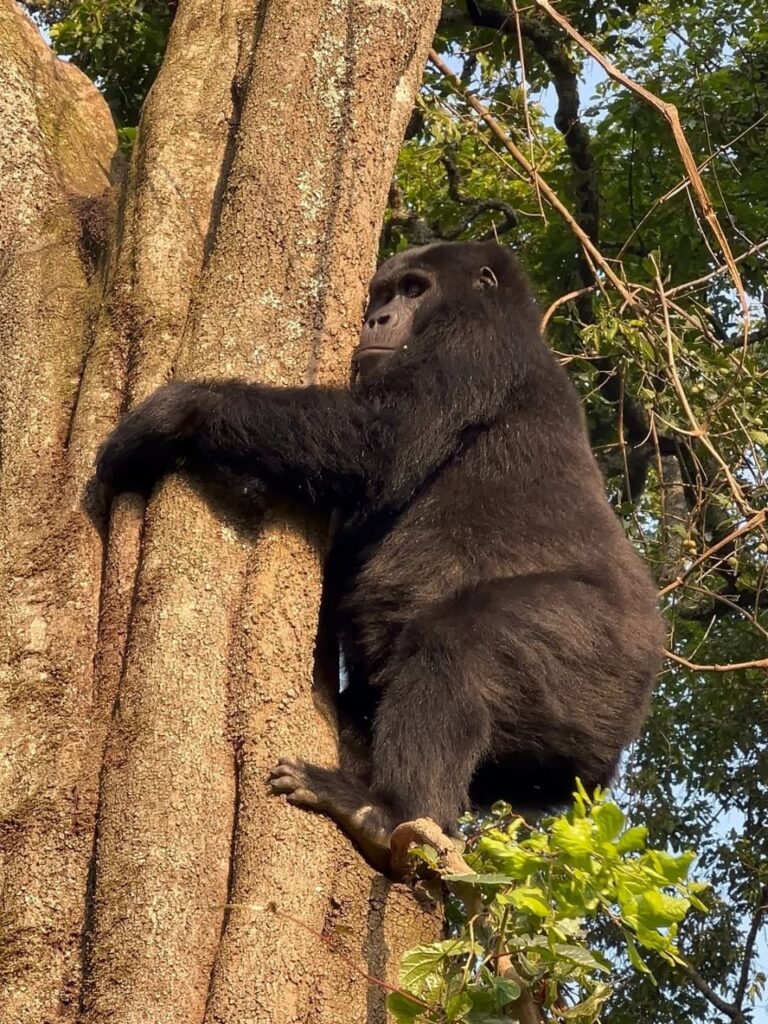
One of the most obvious difference between chimpanzees and gorillas is that the gorillas are larger in size. This implies that adult gorillas spend most of their time on the ground. They rarely climb trees unless it is absolutely necessary. Tree climbing is left to the younger gorillas. Chimpanzees spend most of their time on trees. They are very agile and can move at incredible speed on top of the trees. This makes it harder to see or take good photos of them. Chimpanzees are very lively and noisy while gorillas are more gentle. Despite the drama and noise among chimps, you get the feeling that you are part of them. Members of a gorilla group are very close and protective of each other. Another noticeable difference between gorilla tracking and chimp trekking is that gorillas live in colder and higher altitude with more difficult terrain. Chimps live on lower and flatter ground and hence the trek is not as demanding or tiring.
To see both primates, you will need a permit. Gorilla permits in Uganda cost $800 while chimp permits cost only cost $250. Only a certain number of people may visit a particular gorilla group or chimp community in a day. Chimpanzee trekking can be arranged in two sessions (morning and afternoon) while gorilla trekking can only be done in the morning. In Kibale Chimpanzee Trekking is now done three times a day. For both activities, you need good hiking boots and the right clothes to have the best possible trek. The minimum age for Chimpanzee Trekking in Uganda is 12 years. You can read more about the difference between Chimpanzee trekking and gorilla trekking.
The chimpanzee Habituation Experience in Kibale
Apart from the high chances of spotting chimps, Kibale National Park is special because visitors are offered the opportunity of going for the chimpanzee habituation experience. This activity is different from standard chimpanzee tracking because it involves spending a whole day with the chimps. The experience is special because you learn more and contribute to the chimpanzee habituation process under the guidance and attention of researchers and experienced trackers.
The park authorities have set aside four chimp communities for research and tourism purposes. The one in Kanyawara consists of between 50 to 60 individuals and is open to tourists. The one in Sebitoli has been set aside for research purposes while the one in Kanyanchu is the most visited. The fourth habituated community is located at the center of the park with over 200 individuals.
The chimpanzee habituation experience starts much earlier than usual at 5:30am. The reason is so that you can find them while still sleeping in their nests. You then follow them throughout the day until 7:00pm when they make their night nest. By the end of the activity you would have learnt a lot more than what you would with normal chimp tracking. You would have known each individual chimp by and seen them foliage both on the ground on the trees. The photos are better and the researchers will share with you detailed information about chimpanzees and their conservation programmes in Africa. The chimpanzee habituation experience is popular during the low season (rains) when there are fewer visitors to the park.
The best time to for chimpanzee tracking in Kibale
Uganda has two rainy and dry seasons like most countries located along the equator. The rainy seasons are between April to May and October to November while the dry season falls between December to early March. The best time for chimpanzee trekking in Kibale forest is during the drier season. However, given the popularity of the forest for chimp tracking, it can get crowded during the dry season. If you have come to see the chimps alongside other activities and wildlife adventures in the other game parks, then the dry season would be ideal. I would recommend that you visit during the low season if you have come to see only the chimps in Uganda to avoid the crowds. Besides, Kibale is a rain forest and the rains should be expected any time of the year. If possible, book for the morning session because the weather in the afternoon is unpredictable (rains are common).
Note: Are you wondering how to reach Kibale National Park? Well, if you are traveling on your own, you need to get a bus or taxi in Kampala city which will take you on a 300 kilometer journey to the town of Fort Portal. From Fort Portal you will drive for 36 kilometers to the Kanyanchu visitor center. The most convenient way to reach the park for international travelers is to book your safari with a reliable tour company. They will take care of everything including meals, transportation, accommodation and a Guide/Driver.
Rules to be followed while tracking chimps in Kibale National Park
- Chimpanzee trekking in Kibale is open to those who are at least 12 years old. However, exceptions can be made if a child is old enough, fit, strong and able to follow instructions from the Rangers.
- Only six people may track a particular community of chimps per session. Too many unknown faces may get the chimps nervous and agitated.
- Always listen and follow instructions from your Guide. They understand the chimps quiet well and know what they are talking about. You cannot enter the forest without an official Guide.
- You cannot track chimps when sick or ill with transmittable diseases like flue, cough or diarrhea.
- Chimps more unpredictable compared to gorillas. Keep a distance of about 8 meters from the nearest chimp.
- Eating food close to the chimps is not allowed. They may grab the food from you violently or forcefully.
- Using flash cameras is not allowed while with the primates.
- Try to have heavy breakfast before going out to track the chimps. Also remember to go to the toilet before heading out to the forest. You never know how long the trek will last. The rangers usually dig a hole for those who wish to go for long calls deep in the forest.
Packing List for chimpanzee trekking in Kibale National Park
In order to have the most memorable experience tracking the chimps, we recommend that you come with the following items: –
A backpack: A light back-pack to carry your important items like cameras, binoculars, snacks and spare clothes
Hiking boots: The shoes need to be sturdy, with good traction and resistant to water. You will be climbing slippery and muddy slopes.
Clothing and stockings: The clothing should be suitable for cold weather and a rain jacket. The shorts and trousers should be long-sleeved to protect you from sharp grass and insects. Stockings should be able to dry quickly, woolen (if possible) and water resistant (if possible).
Insect Repellents: Do not forget an insect repellent. There are all kinds of insects in tropical rain-forests. Most are harmless but will still bother if they can find their way to you.
Camera and binoculars: A good camera to capture the special moments with the chimps and a binocular to spot them while still on top of the trees. The binoculars and camera shouldn’t be too heavy to make you tired. The camera should have good zoom lenses to capture good photos of the chimps while on top of the trees. No flash cameras are allowed.
Drinking water and packed snack: This is important in case the activity goes longer than expected and you find yourself hungry or thirsty.
Other activities within Kibale Forest National Park
Primates walk:
Apart from chimpanzees, Kibale is home to 12 other smaller primates. The park is often referred to as the primate’s capital of the world because of the sheer variety and concentration of primates. Unfortunately, you can’t have everything. Kibale has no mountain gorillas. Had it been the case, it would be one of the most visited national parks in Africa. As you track the chimps, you will also encounter red-tailed monkeys, L’Hoest’s monkeys, blue monkeys, baboons, bush babies, pottos, grey cheeked mangabey, black and white colobus.
Birdwatching:
Uganda is blessed with an incredible variety of birds and Kibale forest is one of the best places to go for bird watching in Uganda. Among the over 375 species available include the African grey parrot, Blue-breasted Kingfisher, Blue-spotted Wood Dove, Double-toothed Barbet, Great Blue Turaco, Green Crombec, Hairy-breasted Barbet, little Greenbul, Lizard Buzzard, olive long-tailed cuckoo, Pygmy Kingfisher, Western green tinker bird, Winding Cisticola, Woodland Kingfisher, Zitting Cisticola, Black and white Casqued Hornbill
Nature Walks:
Nature walks in Kibale National Park are arranged to give tourists an opportunity to have close encounters with forest creatures like monkeys, butterflies, birds, insects and. The nature walks are arranged in three sessions – two in the morning and one in the afternoon. The activity starts from the Tourist Centre in Kanyanchu and can take up to three hours. As you go the walk, you will encounter several small primates and birds. You might even be lucky to see the chimpanzees along one of the established trails. The park arranges night walks aimed at spotting nocturnal primates like the bush babies and pottos. Night nature walks start from 8:00 pm to 10:00 pm.
Visiting Bigodi Wetland Sanctuary:
The Bigodi wetlands are located close to Kibale forest and one of the best places to spot birds in Uganda. It is also a great place to spot primates and butterflies. The activity involves walking through a 4.5 kilometer trail to spot over 139 species of birds under the guidance of experienced Guide. The Bigodi Wetland Sanctuary is managed by the Kibale Association for Rural Development (KAFRED) – a community based organization. The organization also manages the Magombe swamp. KAFRED organizes walks around the swamps using established trails and boardwalks. The swamp has rich vegetation and especially the papyrus which are breeding grounds for countless birds.
Visiting the Crater Lakes:
The great African rift valley passes through much of western Uganda leaving behind several crater lakes. The lakes are divided into four clusters – The Kasende Cluster, Katwe Cluster, Fort Portal Cluster and the Bunyaruguru Cluster. The Kasende cluster is found in the western part of Kibale. The Katwe cluster on the other hand is found in Queen Elizabeth National park (close to Mweya Lodge). The Kasende cluster in Kibale National Park has got several lakes which act as sanctuaries to rare birds that are endemic to the area. Visiting these lakes offer amazing scenery and the opportunity to experience great wilderness and nature.